This post was originally published on Ignited Pennings, a blog encouraging teens to live on fire for the Lord in all that they do. The author behind the blog, newsletter, and podcast (Counter-Culture Teen), Victoria Julieann, has a mission to defy (or counter, if you will) the culture that the world pushes on Christians so that instead, we can live for Christ.
~ ~ ~
In Gerta Gerwig’s adaptation of Little Women, Amy March, the youngest daughter in the March family, wants to be known as more than just ‘Amy’ or ‘the youngest daughter.’ She tells the family friend, Laurie:
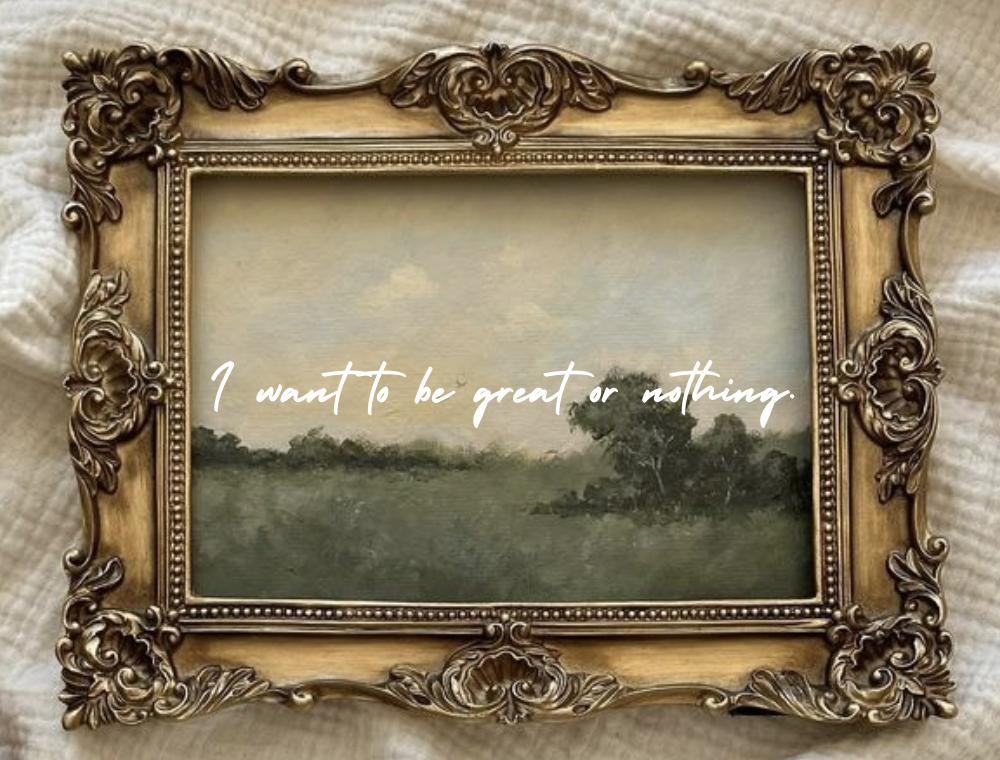
I want to be great or nothing.
This phrase has since resonated with likely everyone who wants to be more than the simple person they feel they are. The question runs through their minds: am I great or am I nothing?
But the truth is that neither of these two extremes are what we are called to be.
You are not called to be great. And you are not called to be nothing.
The devil likes to tell us that if we are not great that we are nothing. And if we’re nothing, then we’re never going to be great. And if we are great, and we become a little bit less great, then we are the equivalent to nothing.
It’s a never-ending cycle of “Who am I? Where is my worth?” that sends us into a spiral of paranoia.
Friend, ‘nothing’ is not your name. But you are not the equivalent of ‘great’ either.
God is great. God is good. God is God.
We are human. We are mistake-makers. We are imperfect.
But we are not nothing.
God tells us that we are made by His perfect design in His perfect image.
‘So God created mankind in his own image, in the image of God he created them; male and female he created them.’
Genesis 1:27 NIV
Scripture says that we are fearfully and wonderfully made.
‘I praise you because I am fearfully and wonderfully made; your works are wonderful, I know that full well.’
Psalms 139:14 NIV
And Scripture says that we are children of God.
‘See what great love the Father has lavished on us, that we should be called children of God! And that is what we are! The reason the world does not know us is that it did not know him.’
1 John 3:1 NIV
As humans, we are not designed for greatness.
In the Bible, just after the Lord made humans and creation, He actually tells us to “[b]e fruitful and increase in number; fill the earth and subdue it. Rule over the fish in the sea and the birds in the sky and over every living creature that moves on the ground.”(Genesis 1:28 NIV)
We are not made for stages nor stages made for us. We are not made for fame, nor fame made for us. We are not made for our names to be known by everyone around the world because of our ‘accomplishments.’
As I was walking in the Baltimore airport last week, I came across the kid’s playroom with a quote from a Diary of A Wimpy Kid book:

I have nothing against the Diary of a Wimpy Kid series and I’m well aware of the full quote from the book:
“I’ll be famous one day, but for now I’m stuck in middle school with a bunch of morons.”
-Greg Heffley
However, slapping this on a wall for children to read will teach them to live with this mindset: I am going to be famous one day.
And for a child, that dream sounds amazing—but as we get older, we start to realize the consequences of becoming famous and being known around the world. It impacts our mental health. It changes our relationships. It chips away at our dignity until we become simply known as figures of whatever role we have to play.
But to plant the message of “I’m going to be famous” in a child’s mind gives them the wrong idea of what their goal and purpose in life is supposed to be. It communicates that’s what all life is about—growing up to be famous, and if you’re not? Well, apparently you’ve failed.
The Gen Z culture is so focused on growing your name and personal platform and the gains you can make from that. Apparently, this generation wants to become famous more than the other generations do—but here’s where the desire wrong:
While a lot of people genuinely want to be famous, their innermost desire is to be truly seen.
And in a lot of peoples’ minds, being truly seen means being seen by as many people as possible.
But we do not have to put ourselves on a pedestal or platform or get thousands of views to be seen by God. In fact, we read in Scripture that the Lord sees us at all stages of life, and it’s easiest to see God when we are looking up at Him, not down on who we think He is.
I love looking at the story of Elijah in 1 Kings 19—Elijah is fearing for his life, certainly not feeling great, feeling like nothing, and he says, “I have had enough, Lord.”
Thinking about this scene, I can just picture Elijah looking up at the sky, battered and worn, longing for a chance to just rest, to have the weight removed from his shoulders. As he’s staring up, he pleads and cries: “God, give me a chance to see Your goodness. I don’t see how You’re working in this. If this is all there is to life, then I have had enough.”
But he sees and experiences the Lord, and not only that but God makes it clear that He sees Elijah. Like how He saw Nathanael under the fig tree, like how He saw Hagar in the desert, like how He saw the Israelites in exile (Exodus 3:7).
Because it often takes a moment of weakness to see what God’s character is truly like. Scripture tells us that it doesn’t depend at all on ourselves—it’s entirely based on God’s grace.
He has saved us and called us to a holy life—not because of anything we have done but because of his own purpose and grace. This grace was given us in Christ Jesus before the beginning of time[.]
2 Timothy 1:9 NIV
In Romans, Paul writes about what grace truly is. He says that if grace were based on works, grace would no longer be grace. (Romans 11:6)
If we are only living our lives to be great in order to repay Christ for His sacrifice, then we are discrediting that very sacrifice.
Jesus did not die so you can live up to your ‘greatness.’ He died for you to glorify God and live freely in His truth.
The Lord does not determine our worth by greatness. The human idea of greatness is ever-changing and shifting. Even fame, a common definition of being great, is temporary, and will someday impact your life in a way that is more of a curse than a blessing.
There are more things I could say about greatness and whether or not we are ‘made’ to be great—and this topic is something that will likely be relevant for all of our time on earth.
But here are the most important points:
Although humans desire to be great, that is not how our worth is determined.
Christ does not depend on our ‘greatness’ to make us feel seen or to see us.
Some of the most influential apostles and disciples in the Bible are ones who would be declared as ‘nothing.’
And Jesus sees both the ‘greats’ and the ‘nothings’ of this world.
Paul writes this in his first letter to the church of Corinth:
‘Brothers and sisters, think of what you were when you were called. Not many of you were wise by human standards; not many were influential; not many were of noble birth. But God chose the foolish things of the world to shame the wise; God chose the weak things of the world to shame the strong. God chose the lowly things of this world and the despised things—and the things that are not—to nullify the things that are, so that no one may boast before him.’
1 Corinthians 1:26-29 NIV
This is simply proof and reassurance that God calls us as we are because He will use who we are for His divine plan and purpose.


Leave a Reply