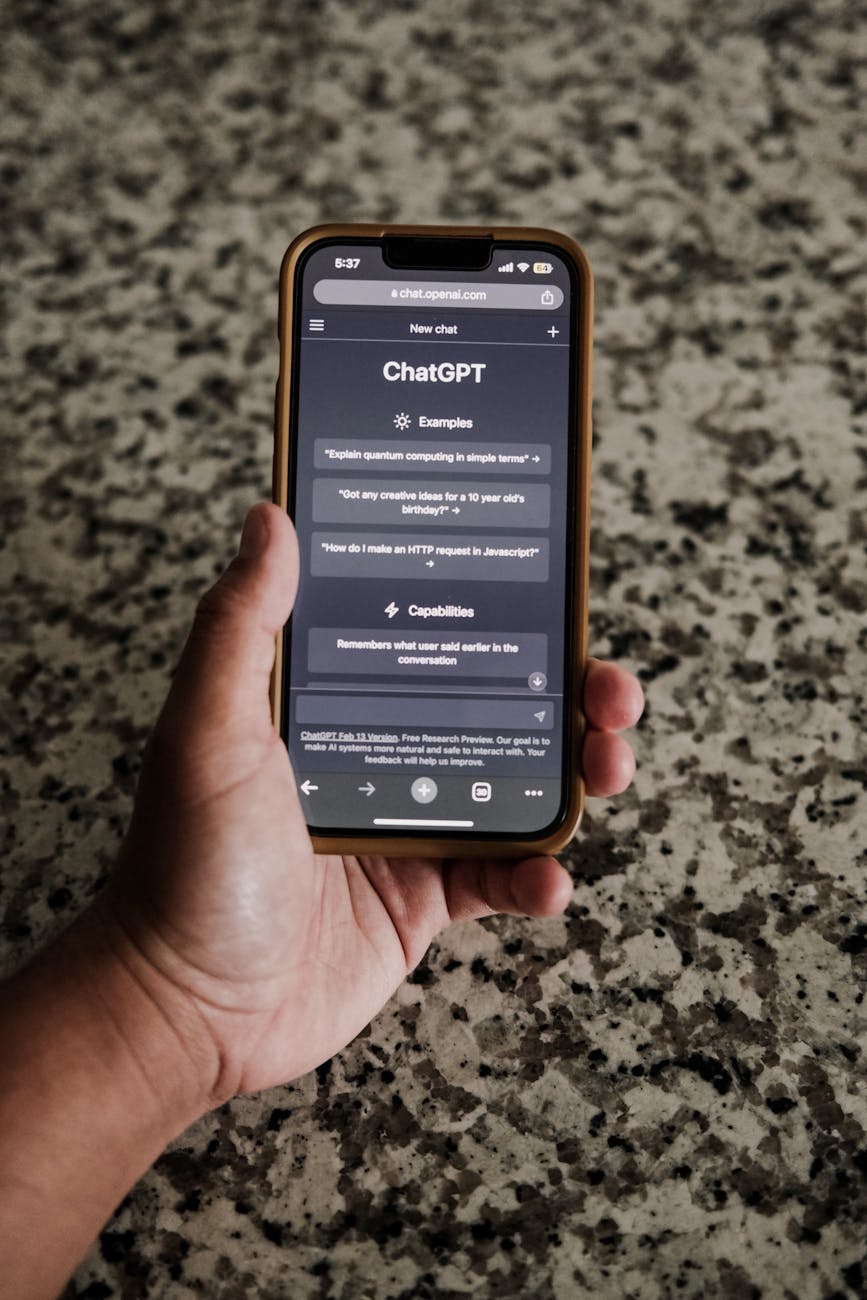
[Note: I understand that this is a controversial subject. I’m still learning about AI and I know that many people who know more than me likely have stronger opinions. But just know—these are thoughts. Not declarations or announcements—just ways I’ve found helpful for navigating AI because we can all agree that it is a very real thing, no matter if we support it or are fully against it. Thank you!]
Let’s face it: AI is an ever-present thing in our culture. We are slowly becoming adapted to asking AI questions, having it help us with our homework, or figure out a flirty-but-subtle way to talk to that cute guy in your science class.
But is AI something we should be using? And if we do use it, how can we set boundaries so we can use it wisely?
Every now and then I use ChatGPT for something, asking a question that the Internet can’t help me with or provide an answer to. Often if it’s I need to find a book or song or author/pastor that I know details about but can’t remember the name of. I give the info and ChatGPT throws out possibilities for me because Google just isn’t capable of giving that kind of information. (Or for tech help—it is VERY helpful for me then.)
But I have found that it has caused me to be, well, lazy. Can’t think of a good story title? Let’s tell ChatGPT the themes of my book and hope it’s good at alliteration…
And in all honesty, it does a great job sometimes. But it’s not original, it’s not creative, and it’s not mine.
I’ve made sure to set a very firm boundary for myself—no using AI of any sort for blog posts. No inspiration, no images, no title ideas, no nothing. It just feels fake to me: I’m creative, why not use this creativity?
But at this point, AI is so commonly found everywhere we go. It’s not something we can simply avoid. It’s on basically every website, when you Google something it can summarize what you found, it’s on various apps, there are AI dating apps, there are AI images everywhere, and more.
I recently got a new phone and AI was already installed into it; summarizing messages on my lock screen, connecting Siri to ChatGPT, and there was an app to create AI images by using just a few words to describe what I wanted. Heck, no! The immediate answers that I could get made me annoyed. Just let me take five seconds to open my phone to read the actual message please, not a summary. (I ended up disabling it.)
Now, this isn’t to say that AI is bad. It’s a brilliant, ingenious creation! But it’s becoming something so ever-present in our world that we have to be careful with how we use it—especially for things like our crafts, community, and our faith. Yes, these are three very different things, but let me explain.
The growth in our crafts—art, writing, song-writing and music, and photography—are very likely to be stunted if we access or use AI for them frequently. Sure, it may just be a quick title-inspo, but that could lead to points that make your argument, which could then lead to asking AI to write a whole post. Same goes for art, song-lyric inspiration or help, creating photos, and all sorts of things.
It doesn’t just affect people’s jobs, but it affects the growth in your craft. Who will finish that WIP you’ve been working on for three years? A robot or YOU? Having a robot do it might sound easier, but where will the satisfaction be? You won’t be able to say you wrote a novel—but AI sure can!
Now, I’ve talked about the reasons we shouldn’t use AI when working on our crafts. But there are ways AI can be helpful.
So how should we use AI?
Well, there’s not really a ‘we should do this’ or ‘we should do that,’ because everybody has different opinions on AI and their usage of it. But there are ways we can navigate it wisely, whether we use it often or whether we use it sparingly.
- Set a boundary for yourself. Whether this is the amount of time you spend using it or questions you ask or what kinds of things you ask, you will need a boundary. If you are using AI to write a blog post, then…well, maybe don’t do that. But if you are looking for a resource for that blog post, then AI will give you an abundance of sites or books that you might be looking for! You’re not plagiarizing or taking an idea that’s not your own. (Yes, an AI is still not your own, even if you prompted the AI to do it.)
- Don’t post an image or sentence or something and say that YOU created it. That’s self-explanatory. It’s not your own creation, so it’s not something you can take credit for—it doesn’t matter if anyone knows, this is just standard etiquette.
- Don’t seek it for community. AI, as friendly as it might appear, is not a real human. It doesn’t have feelings, it doesn’t know you or your story. It’s simply programmed to respond that way. AI is not supposed to be a replacement for community, just like it is not supposed to be a replacement for hard work. Find real humans, talk to them, and don’t reply on AI to be your therapist.
- Don’t make it your pastor. Yes, you read that right. If you’re not careful, you can start turning to AI for spiritual counseling and guidance—even though it knows little to nothing about real faith. Does it know a lot about the Bible itself? Yes. Does it have access to thousands of messages on whatever topic you’re looking for? Yes. And could it write you a response of how you can strengthen your faith, create better habits, and summarize preachings for you? Also yes. But again: it’s not a replacement for community, real human interaction, or genuine faith. Talk to a human, not an AI pastor.
So in summary? AI is a big part of our world—but that doesn’t mean it has to be a big part of us and our work.
And that’s all I got for today! I’d love to hear your thoughts on AI (but obviously, be aware that others might have different opinions.)
Thanks for reading! Have a great day.
~Willow
[Funny thing I found in the Bible: look up Joshua 8 and read the title. It just made me laugh when I opened my Bible the other night. Some good ol’ Bible humor for ya.)


Leave a Reply